

Žurnal in English
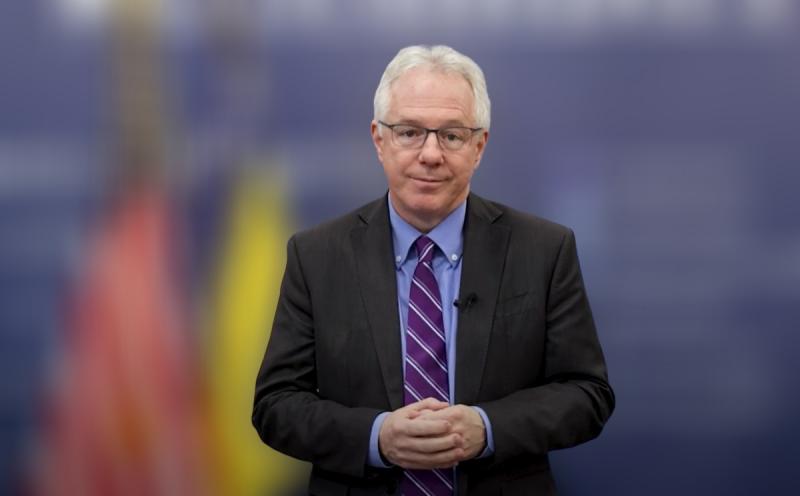
Michael Murphy, former US ambassador to Bosnia and Herzegovina (2): The current administration is not taking the threat posed by Dodik seriously
We are publishing the second part of the big interview that the former, now retired, ambassador of the United States of America to Bosnia and Herzegovina, Michael Murphy, gave to the Journal in a big interview for speeches about the election of the high representative, the further role of the OHR, the Bonn powers, the policy of the US administration towards BiH and the EU, lobbyists Milorad Dodik, Dragan Čović, corruption.

- By focusing primarily on economic stability and geopolitical interests, the United States risks strengthening local authoritarian leaders who maintain the appearance of stability while undermining democratic institutions from within. Many analysts argue that the international community is increasingly abandoning efforts to strengthen the Bosnian state in favor of managing relations among the country's three dominant ethno-national blocs. Do you believe that is the direction events are taking?
Let me start with this observation. Stability is not a dirty word. Without it, BiH cannot build the peaceful, prosperous, and democratic society its people want for themselves, their children, and their grandchildren. As I argued earlier, the international community has had too much faith in the capacity of the European perspective to tame ethnonationalism and transform BiH politics. Just look at the current impasse over what are fairly easy asks from the EU for BiH to open accession negotiations and access WBGP funds. This progress is not being blocked by the OHR or the High Representative. The claim that the continued presence of either is preventing BiH’s rapid entry into the EU is silly at best and cynical at worst. Again, the EU would help itself and BiH citizens if it publicly placed the finger of blame for these problems where it belonged rather than apportioning blame equally across all leaders and parties.
While the European perspective remains very important, other tools are required to create the conditions necessary for BiH to survive and thrive. These include, but are not limited to, the OHR, the Bonn Powers, and a credible and capable EUFOR. Ultimately the international community will have to deal with unsavory political leaders, but there is a difference between that and empowering these leaders through benign neglect or backroom compromises designed to appease them. It is clear, I think, that these approaches do not work.
In some quarters, I think there is a misplaced expectation that it is the international community’s job to build a unitary or civic state in BiH. Since the Dayton Agreement was signed, the United States has never advocated creation of a unitary BiH, and it has consistently supported the concept of constituent peoples. To claim otherwise is ill-informed or a deliberate misrepresentation. The current administration disingenuously labels U.S. efforts to preserve the DPA and protect BiH institutions from the threats posed by ethnonationalist politicians as “nation building.” They are not the same thing. Safeguarding the core American strategic interest in BiH – the country’s territorial integrity – is not “nation building”. It is smart policy.
- The tone of the latest State Department report on the Western Balkans differs significantly from many previous U.S. policy documents on the region. Rather than viewing the Balkans primarily through the lens of conflict and crisis, the report presents it as a region of investment opportunities and strategic cooperation. How do you interpret this apparent shift in approach?
I think it is a mistake to discount the Western Balkans’ importance to the security of the United States. Don’t get me wrong, I think it is important for the United States to pursue its economic interests in the Western Balkans, including investment opportunities for American businesses. I spent time as Ambassador to Bosnia and Herzegovina doing that, as did my American colleagues throughout the region, but for all of us, at the heart of U.S. policy was an appreciation for how the region’s security and stability impacted United States. This is why the United States has supported the Western Balkans’ integration into Euro-Atlantic institutions, and it was why we supported the DPA and BiH’s territorial integrity. Our pursuit of these interests was and is perfectly compatible with pursuit of our regional economic interests. In fact, I would argue the attention we pay to our security interests in the Western Balkans makes it easier to secure our economic interests, too. We need to be doing both. To make this concrete, I close with this. Does anyone seriously believe the Southern Interconnection will get built if Mr. Dodik is allowed to press ahead with his agenda for dissolving BiH?
- In a post on X, you wrote that the new U.S. administration appears willing to work with Milorad Dodik while he continues to pursue secessionist policies and destabilise Bosnia and Herzegovina, all while paying lobbyists in Washington to advance his political interests. How effective do you believe Dodik's lobbying strategy has been, and what results can it realistically achieve?
I am not in a place to measure the effectiveness of Mr. Dodik’s lobbyists. They may have been pushing on an open door when they began approaching the administration. It is certainly true that some in Washington have accepted at face value Mr. Dodik’s litany of false historical, political, and legal claims about BiH and U.S. policy towards BiH. It is also clear that not everyone in Washington buys what the lobbyists are selling, as the commentary and actions of leading foreign policy thinkers on Capitol Hill demonstrate. At a minimum, the lobbying may have contributed to the now clearly bad deal the administration made with Mr. Dodik in October 2025. While the administration delivered on its part of the bargain, Mr. Dodik and his allies have effectively reneged on theirs. Mr. Dodik’s ethnonationalism remains the most destabilizing force in BiH, and he is openly pursing RS independence. He even has lobbyists advocating for it in Washington. This is not hard to discern.
- When the State Department lifted sanctions on Dodik, one of the reported conditions was that the authorities in Republika Srpska repeal legislation aimed at rolling back certain state-level competencies. Put simply, the expectation was that tensions would be reduced. Yet we continue to see blockades of state institutions, increasingly radical rhetoric and ongoing secessionist threats from Dodik and his political allies. Has Dodik simply become uncontrollable, or was this entire process designed to make a shift in U.S. policy toward Bosnia and Herzegovina more politically acceptable?
I said at the time that the repeal of the RSNA legislation and conclusions was welcome, if incomplete, but I also warned there was much more work for the administration to do to advance U.S. interests in BiH, especially with regard to ensuring the RS ruling coalition respected the DPA, the state of BiH, and BiH institutions. I noted at the time that the international community had a long history of making poor deals with Mr. Dodik. Finally, I warned that if there was no effort to hold the RS ruling coalition accountable, and if Mr. Dodik continued to pursue his anti-Dayton agenda, then this deal would fail just as past deals with Mr. Dodik have. Well, that is certainly what it looks like today, and as far as I know, the administration has done nothing to address it.
- Recent reports suggest that the State Department is considering reimposing sanctions on Dodik because of these developments. How realistic do you think such a scenario is?
I saw that statement, but I am sorry to say, I question its sincerity. Mr. Dodik has given the administration ample reason since October 2025 to speak out about his rhetoric and agenda, but it has not done so. My sense is some people within the administration were concerned Mr. Dodik’s rhetoric could complicate efforts to secure their preferred candidate for High Representative. So, they put out a statement they thought might reassure the PIC and others about their embrace of Mr. Dodik. I have not seen compelling evidence that the current administration takes seriously the threat Mr. Dodik poses to BiH’s territorial integrity but I would welcome being proven wrong.
- What does it specifically mean to reconsider the role of the US in the international presence in Bosnia and Herzegovina and what would the US withdrawal mean for Bosnia and Herzegovina, and the region as well?
Well, I am not certain precisely what the people who drafted that statement meant. It reads like a threat to withdraw from the PIC and stop supporting OHR if PIC member states do not approve the candidate for High Representative proposed by the United States. It is impossible for me to judge how serious the authors of that statement are or whether their approach enjoys the support of the Secretary of State. If the statement is genuine and serious, then it is terrible policy that is putting personal pique ahead of U.S. strategic interests in BiH and the region.
- In one of your comments, you stated that 'one ethno-nationalist leader in Bosnia and Herzegovina is threatening to withdraw from the EU accession process unless it proceeds on his terms, while another is providing him with de facto political support, undermining claims that he and his party fully support EU integration.' I assume the second leader you were referring to was Dragan Čović, president of HDZ BiH. Public debate increasingly revolves around constitutional reform, the idea of a third entity and special electoral units—issues that many argue further destabilise the country and hinder its European path. At the same time, HDZ BiH remains closely connected to HDZ Croatia and Prime Minister Andrej Plenković, who must balance domestic political interests with Croatia's obligations within the EU. How do you see Croatia's role in the current tensions between Washington and Brussels regarding Bosnia and Herzegovina?
Yes, the second leader to whom I was referring is Mr. Covic. The United States has consistently opposed further division of BiH, including the creation of a third ethnoterritorial entity. The Secretary of State reiterated this policy during his Congressional hearings last week. That does not mean the United States opposes the concept of constituent peoples enshrined in the DPA. It doesn’t and it hasn’t. For reasons that I do not think I need to detail, it is untenable to create a unitary, fully centralized BiH. Support for effective and efficient state-level institutions that are capable of carrying out the functions necessary for BiH to survive and thrive – border control, the conduct of foreign trade, or meeting BiH’s international obligations, including EU obligations – does not constitute support for unitarization or centralization. I do not want to speculate on the role, if any, that Croatia is currently playing to ease any tensions between Washington and Brussels. I just do not know. I think Croatia can play a constructive role in BiH, not least by supporting its EU aspirations, and by pressing its political leaders, including Mr. Covic, to make the compromises necessary to realize these aspirations.
- Since your departure as U.S. Ambassador to Bosnia and Herzegovina, the embassy has been headed by Chargé d'Affaires John Ginkel. It has recently been announced that Ronald Johnson will become the next U.S. ambassador to the country. What do you know about him, and what should Bosnia and Herzegovina expect from his appointment?
I do not know Major General Johnson. I imagine that his focus right now is preparing for his Senate confirmation hearing. I cannot predict what the future holds in terms of his mandate, but I would expect, like every U.S. ambassador, he will faithfully execute the policy of the administration in which he serves.
(zurnal.info)